|
Introduction Anthracene is a polycyclic aromatic hydrocarbon (PAH) composed of three linearly fused benzene rings and has long attracted considerable attention from chemists and materials scientists due to its unique structural and electronic properties [1]. Owing to its extended π-conjugated system, anthracene and its derivatives exhibit remarkable photochemical and photophysical characteristics, including strong fluorescence, charge transport behavior, and the ability to form supramolecular gel-like assemblies [2]. These properties make anthracene-based compounds highly attractive as functional organic materials. Anthracene derivatives are widely investigated as important organic building blocks because of their favorable photophysical and electrochemical properties, ease of structural modification, and early demonstrated electroluminescent behavior [3,4]. As a result, they have found promising applications in organic light-emitting diodes (OLEDs), organic field-effect transistors (OFETs), optical and electronic switches, scintillation detectors for high-energy photons and particles, and functional materials incorporated into mesophases, polymers, films, and crystalline systems [5,6]. Furthermore, increasing global interest in hydrogen-based energy technologies has stimulated new investigations into the potential use of anthracene derivatives in magnesium hydride systems [7]. Meng et al. also reported anthracene-oligomer-based semiconductors with high field-effect mobility and excellent operational stability, further demonstrating the technological importance of anthracene-containing materials [8]. In addition to their technological relevance, anthracene derivatives have attracted significant interest because of their pronounced biological activity, particularly their interactions with tumor cell lines. Their planar conjugated structure facilitates effective interaction with DNA base pairs, which is closely related to their biological effects and potential pharmaceutical applications [9]. The structural versatility of the anthracene framework also enables the synthesis of numerous functional derivatives with tunable physicochemical and biological properties. More broadly, polycyclic aromatic hydrocarbons (PAHs) constitute an important class of compounds in modern materials science and organic electronics [10]. PAHs are considered promising precursors for the bottom-up synthesis of structurally defined nanocarbon materials and graphene-like architectures [11-13]. Their unique optical and electronic properties additionally provide significant opportunities for biological and optoelectronic applications [14]. However, despite their technological value, many PAHs are recognized as hazardous environmental pollutants generated by anthropogenic activities, and their carcinogenic nature has motivated extensive research into PAH removal and transformation technologies [15]. Coal tar is a complex by-product formed during the high-temperature carbonization and gasification of coal for the production of coke and gaseous fuels [16,17]. It is generally obtained as a dark brown or black viscous liquid or semi-solid material with a characteristic odor, formed together with aqueous ammoniacal liquor during cooling of volatile products generated in coal processing [16]. With the increasing development of coal gasification technologies as alternative energy sources, the generation of coal-derived by-products such as coal tar, sulfur compounds, ammonium sulfate, and crude benzol has become an important environmental concern [17]. Coal tar is an exceptionally complex mixture containing hundreds of organic compounds, many of which possess significant industrial value [18]. Its composition includes aromatic hydrocarbons such as benzene, toluene, xylene, naphthalene, anthracene, and related polycyclic aromatic hydrocarbons (PAHs), as well as phenolic and nitrogen-containing heterocyclic compounds [18,19]. These substances are widely used as raw materials and intermediates in the production of synthetic fibers, engineering plastics, dyes, pharmaceuticals, preservatives, perfumes, pesticides, resins, and other industrial chemicals [19]. Because of this chemical diversity, coal tar is considered an important feedstock for the recovery of high-value aromatic compounds. Despite its industrial significance, coal tar and coal tar residues (CTR) are recognized as hazardous environmental pollutants due to their high content of toxic and carcinogenic PAHs [20,21]. The migration and distribution of coal tar contaminants in water systems are influenced by interfacial molecular diffusion and the high viscosity of the tar phase, which significantly affects mass-transfer processes [19-21]. Consequently, considerable attention has been devoted to the development of efficient technologies for PAH removal, separation, and valorization. Recent studies have demonstrated the potential of microwave-assisted extraction for reducing priority PAH content in coal tar residues [22]. In addition, increasing interest has been directed toward the selective isolation of valuable compounds from coal tar for the preparation of advanced carbon materials and functional resins [23]. Various carbonaceous adsorbents, including chars produced from biomass pyrolysis and activated using CO2 or steam, have also been investigated for tar removal from syngas streams [24,25]. The physicochemical properties and applicability of such chars strongly depend on their mineral composition and heavy metal content [26]. In this work, methylanthracenes were isolated from coal tar-derived fractions and structurally characterized using FT-IR, NMR, and GC-MS techniques. Their selective nitric acid oxidation to anthracenecarboxylic acids were investigated with emphasis on reaction mechanism and the influence of temperature and time on product yield and selectivity.
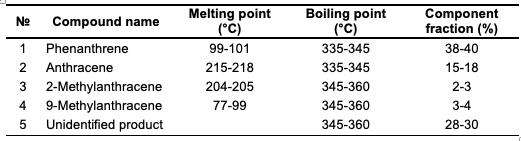
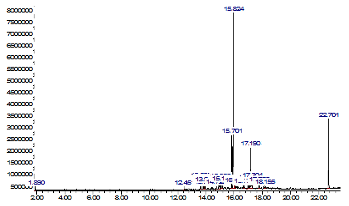
Materials and Methods All chemicals and reagents used in this study were of analytical grade purity (hydrochloric acid, methanol, isopropyl alcohol, and toluene). Method for the Isolation of 2-Methylanthracene For the purpose of isolating anthracene and its derivatives required for this scientific research, a tar-derived sample in the boiling range of 290-360°C was separated under atmospheric pressure into two fractions based on boiling point: 290-330°C and 335-360°C. From the 330-360°C fraction, 700 mL was collected and transferred into a 1000 mL flask together with 3-4 g of boiling chips, followed by distillation setup. The temperature was gradually increased at a rate of 10-15°C per minute. The obtained samples were further identified as anthracene, 2-methylanthracene, and 9-methylanthracene crystals based on their solubility in solvents and melting point characteristics. It was determined that the fraction consisted of approximately 38-40% phenanthrene, 15-18% anthracene, 2-3.5% 2-methylanthracene, 3-4% 9-methylanthracene, and 28-30% phenanthrene derivatives and other compounds (Table 1).
The IR spectra of the compounds were recorded using FT-IR 2000 System (PerkinElmer) and Bruker Invenio S-2021 spectrometers in the range of 4000-400 cm-1. 1H NMR spectra were recorded on a Unity+600 (Varian) spectrometer operating at 600 MHz using CD3OD, CDCl3, DMSO-d6, and pyridine-d5 as solvents. Tetramethylsilane (TMS) was used as an internal standard for 1H NMR measurements. In 13C NMR spectra, the chemical shift of the solvent was used as the reference standard. Initially, it was established that 2-methylanthracene is readily soluble in ethanol; therefore, technical ethanol was used as the solvent. The raw material was first heated with technical ethanol to 40°C. After dissolution, the mixture was filtered, allowing separation from anthracene and phenanthrene derivatives. The obtained filtrate was then cooled to room temperature. The filtered mass was treated with 10% sulfuric acid to adjust the pH to 2-3 and filtered again, followed by neutralization with 10% sodium hydroxide solution to pH 7-8 and subsequent filtration. The resulting 2-methylanthracene crystals were further purified by recrystallization from ethanol and by distillation to remove residual solvent. The product was dried at room temperature for 3 hours. The mass of the obtained 2-methylanthracene crystals was 19 g, corresponding to 2.7% of the total fraction. The obtained 2-methylanthracene was identified as a light-yellow compound with a melting point of 203-204°C and a boiling point of 357°C. Method for the Isolation of 9-Methylanthracene After the separation of 2-methylanthracene from the “tar product”, the remaining fraction was used for the isolation of 9-methylanthracene. First, the mixture was heated to 65-70°C. According to the literature data, the melting points of related compounds are as follows: 2-methylphenanthrene (57°C), 3-methylphenanthrene (63°C), 4-methylphenanthrene (53.5°C), while 9-methylanthracene has a melting point of 77-79°C. Since the melting points of the above phenanthrene derivatives are lower than that of 9-methylanthracene, this difference was used for separation. The mixture was therefore filtered at 70°C to isolate 9-methylanthracene. For purification, 9-methylanthracene was recrystallized from toluene. The compound was then isolated from toluene by evaporation. The obtained 9-methylanthracene crystals were dried in open air for 3 hours. The mass of the obtained 9-methylanthracene crystals, determined using an analytical balance, accounted for 3.56% of the total fraction (23.1 g).
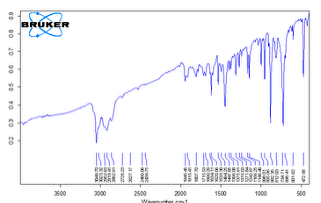
Results and Discussion IR spectroscopic analysis (Figure 1) showed a characteristic absorption band at 3049.70 cm-1 corresponding to aromatic C-H stretching vibrations, confirming the presence of an aromatic ring.
The absorption bands at 2919.41-2862.91 cm-1 are attributed to C-H stretching vibrations of the CH3 group, indicating the presence of a methyl substituent in the molecule. The bands observed at 1620.06-1447.85 cm-1 correspond to C=C stretching vibrations of the aromatic ring system.
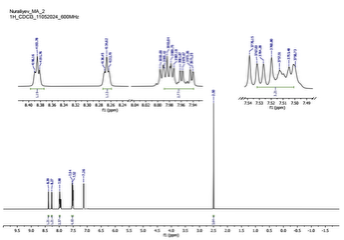
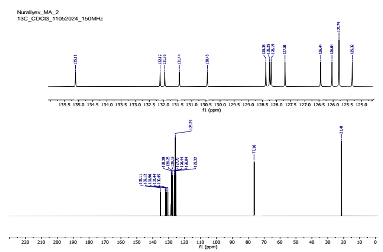
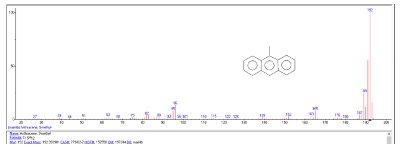
CDCl3) showed signals at δ 8.39 (t, J = 2.11 Hz, 1H), 8.27 (t, J = 1.99 Hz, 1H), 7.98 (ddd, J = 5.82, 3.42, 2.50 Hz, 2H), 7.95 (dt, J = 8.60, 2.10 Hz, 1H), 7.55-7.49 (m, 4H), and 2.50 (s, 3H). These signals are characteristic of aromatic protons of the anthracene framework, while the singlet at δ 2.50 (3H) corresponds to the methyl group. GC-MS analysis showed a molecular ion peak at m/z: theoretical = 192.00, observed [M]+ = 192.00, which is in full agreement with the molecular formula of 2-methylanthracene (C15H12). The 13C NMR spectrum (150 MHz, CDCl3) exhibited signals at δ 135.11, 132.12, 131.96, 131.44, 130.45, 128.38, 128.25, 128.19, 127.70, 126.44, 126.04, 125.79, 125.32, and 21.41 ppm, corresponding to aromatic carbon atoms and the methyl carbon, respectively.
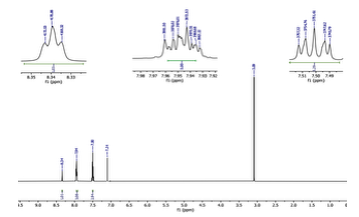
The results of the mass spectral analysis showed that the obtained fraction contains several compounds valuable for industrial applications. 1H NMR (600 MHz, CDCl3) δ 8.34 (t, J = 2.19 Hz, 1H), 7.98-7.91 (m, 4H), 7.54-7.47 (m, 4H), 3.09 (s, 3H). 13C NMR (150 MHz, CDCl3) δ 131.46, 130.54, 129.74, 129.15, 125.47, 125.38, 125.22, 124.99, 15.63. m/z (GC-MS): theoretical = 192.00, observed = [M]+ 192.00 (Figures 5).
The chemical shift values in the 1H NMR spectrum (ppm) depend on the electron density around the protons. As electron density decreases, deshielding increases and the chemical shift value shifts to higher ppm. Protons in aromatic rings typically appear in the range of 7-9 ppm. This is associated with the deshielding effect caused by the circulating π-electron cloud of the aromatic system. Multiplet signals arise due to spin–spin coupling between neighboring protons. The coupling constant (J) reflects the strength of interaction between adjacent protons. Due to the symmetry of the anthracene molecule, equivalent protons give rise to identical signals in the spectrum. 1H NMR Spectrum of 9-Methylanthracene Aromatic protons usually appear as multiplets because protons in aromatic rings are coupled with each other through multiple neighboring interactions. Since these protons are located close to each other within the aromatic system, their signals become complex and often appear as overlapping multiplet patterns. The 9-methylanthracene molecule contains a total of 12 hydrogen atoms: 9 hydrogen atoms are located on the aromatic rings, while 3 hydrogen atoms belong to the methyl (-CH3) group. In the anthracene framework, the aromatic protons exhibit signals corresponding to their different chemical environments, but due to strong spin-spin coupling, they generally appear as multiplets. As shown in Figure 6, several signals are observed in the range of 7.50-8.34 ppm, which correspond to aromatic protons. These signals are characteristic of the anthracene aromatic system.
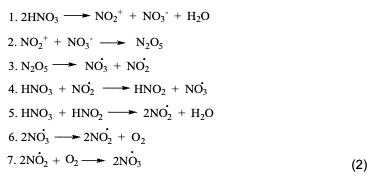
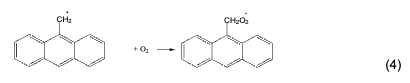
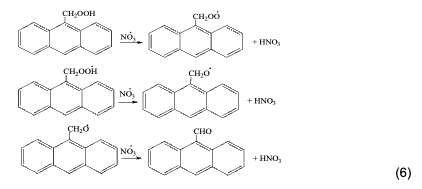
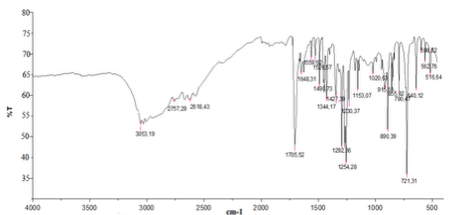
The methyl group protons typically resonate in the 3-4 ppm region. In this spectrum, a singlet signal observed at around 3.09 ppm corresponds to the protons of the methyl group. This singlet appearance is due to the absence of coupling with neighboring protons. The solvent signal (CDCl3) appears at 7.24 ppm, which is typical for deuterated chloroform commonly used as an NMR solvent. The synthesis reactions of the corresponding acids from 2- and 9-methylanthracene were investigated in this work. Initially, 9-methylanthracene was dissolved in acetic acid and subjected to oxidation using nitric acid, leading to the formation of the corresponding carboxylic acid. The reaction equation and mechanism for the oxidation of 9-methylanthracene using nitric acid are presented below (equation 1):Nitric acid initially oxidizes the methyl group (-CH3) at the 9-position of 9-methylanthracene to a hydroxymethyl group (-CH2OH). Due to the stability of the anthracene ring system, the methyl substituent at the 9-position is relatively reactive and therefore susceptible to oxidation. Nitric acid (HNO3) decomposes to generate reactive nitrogen oxide species (e.g., NO2, NO3) that act as radical oxidizing agents (equation 2) [24]. The NO2• radical formed during the decomposition of nitric acid can react with atmospheric oxygen to generate the NO3• radical (as shown in reaction 7). The resulting NO3• radical initiates the oxidation process by abstracting hydrogen atoms from the methyl group of 9-methylanthracene, thereby promoting successive oxidation steps and overall reaction progression. In the initial stage, the NO2• radical, due to its relatively high stability and reactivity, interacts with molecular oxygen to form NO3•. The formed NO3• species then abstracts a hydrogen atom from the methyl group of 9-methylanthracene (equation 3), leading to the formation of a methyl anthracenyl radical. In the second step, after the formation of the 9-methylanthracene radical (RCH2•), it reacts with molecular oxygen (O2) present in the reaction medium (equation 4), leading to the formation of an intermediate peroxide radical (C14H9-CH2OO•). Here, R represents 9-methylanthracene. In the subsequent step, the peroxide radical reacts with methyl anthracene (equation 5), resulting in the formation of a hydroperoxide (C14H9-CH2OOH) and regeneration of the methyl anthracenyl radical. The newly formed methyl anthracenyl radical then re-enters the reaction cycle by reacting again with molecular oxygen in the second step, thereby propagating the oxidation process. In this step, the hydroperoxide (C14H9-CH2OOH) first reacts with the NO3• radical (equation 6) to form a peroxide radical (C14H9-CH2OO•). In the subsequent stage, this intermediate undergoes further transformation leading to the formation of a carbonyl group (C14H9-CHO), which represents an oxidized aldehyde intermediate in the reaction pathway. The final stage of the reaction involves the oxidation of the carbonyl group (-CHO) to a carboxyl group (-COOH). In this step, the NO3• radical acts as an oxidizing agent and converts the carbonyl intermediate into the corresponding carboxylic acid, completing the overall oxidation process (equation 7). The IR spectrum (Figure 7) of the synthesized 9-anthracenecarboxylic acid shows characteristic absorption bands confirming its structure.
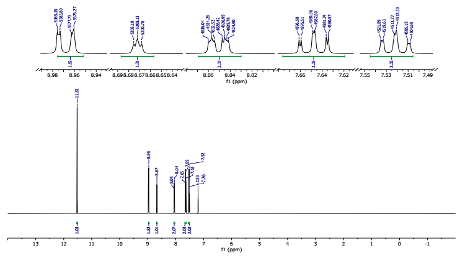
The band observed at 3053.19 cm-1 corresponds to asymmetric stretching vibrations of aromatic C-H bonds in the ring system. A broad absorption in the range of 2618.43-2757.29 cm-1 is attributed to the O-H stretching vibration of the carboxylic acid group. The strong absorption band at 1705.52 cm-1 is characteristic of the C=O stretching vibration of the carbonyl group. Absorption bands in the region of 1559.57-1526.15 cm-1 are assigned to C=C stretching vibrations of the aromatic ring. In addition, the bands observed at 1292.86-1254.28 cm-1 correspond to C-O stretching vibrations, typical for carboxylic acid derivatives. The chemical shift values in the 1H NMR spectrum (ppm) depend on the electron density of protons. A decrease in electron density leads to increased deshielding, resulting in higher chemical shift values. Protons in aromatic rings typically appear in the range of 7-9 ppm, which is associated with the deshielding effect of the aromatic π-electron cloud (Figure 8).
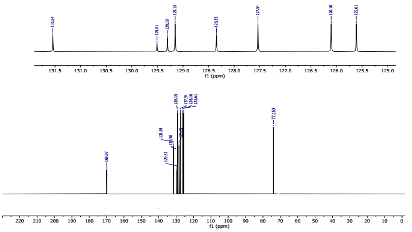
Multiplet signals arise due to spin–spin coupling between neighboring protons. The coupling constant (J) reflects the strength of interaction between adjacent protons. Owing to the symmetry of the anthracene molecule, equivalent protons produce identical signals. Aromatic protons generally appear as multiplets because they are strongly coupled with each other within the aromatic system. Since these protons are located in close proximity, their signals overlap, resulting in complex multiplet patterns. The 9-anthracenecarboxylic acid molecule contains 9 aromatic protons distributed over three fused aromatic rings, as well as one carboxylic acid proton (-COOH). The aromatic proton signals are observed in the range of 7.52-8.96 ppm, corresponding to the aromatic system. The carboxylic acid proton typically appears in the 10-13 ppm region as a singlet, since it does not couple with neighboring protons. In the recorded spectrum, a signal at 11.52 ppm corresponds to the -COOH proton. The solvent signal (CDCl3) is observed at 7.260 ppm, which is characteristic for deuterated chloroform used in NMR spectroscopy. In the 13C NMR spectrum, the compound contains 15 carbon atoms. Carboxyl carbon signals are generally observed in the range of 170-185 ppm, while aromatic carbons appear in the 110-160 ppm region.
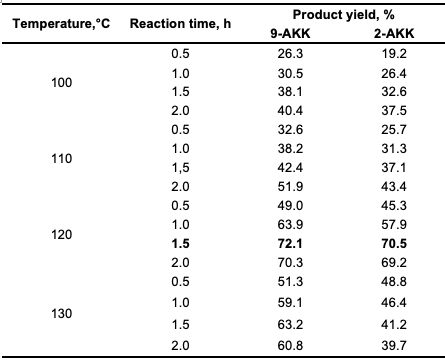
In the spectrum shown in Figure 9, the signal at 170.097 ppm corresponds to the carbonyl (C=O) carbon atom. Signals in the range of 125.61-131.54 ppm are attributed to aromatic carbon atoms. The solvent signal (CDCl3) appears at 77.160 ppm. Based on the above spectral data, it can be concluded that the obtained spectra are consistent with the structure of 9-anthracenecarboxylic acid. The synthesis of 2- and 9-anthracenecarboxylic acids was carried out at 100-130°C with a reaction time of 1-1.5 hours. During the synthesis process, the effects of reaction time, temperature, and solvent nature on the product yield were investigated. To study the influence of temperature on the product yield, a series of experiments were performed. 2- and 9-methylanthracene were used as starting materials, nitric acid as the oxidizing agent, and acetic acid as the solvent. The results of the experiments are presented in Table 2.
Based on the analysis of the results, it was observed that increasing the temperature from 100 to 130°C leads to an increase in the yield of both 2- and 9-anthracenecarboxylic acids. At 100°C with a reaction time of 1.5 hours, the yield of 9-anthracenecarboxylic acid was 38.1%, while the yield of 2-anthracenecarboxylic acid was 32.6%. At 120°C, the yields increased to 72.1% and 70.5%, respectively. This behavior can be explained by the acceleration of nitric acid decomposition at elevated temperatures, resulting in an increased concentration of reactive species that facilitate the oxidation of 2- and 9-methylanthracene. However, when the temperature was raised to 130°C and above, side reactions began to occur, including further oxidative transformations and partial degradation of the aromatic ring system, which negatively affected the product yield. In addition, it should be noted that the formation mechanisms and identification of by-products were not investigated in this study. The decrease in product yield at higher nitric acid concentrations is mainly attributed to the formation of nitro derivatives of 2- and 9-methylanthracene as well as partial ring cleavage reactions. Conversely, reducing the nitric acid concentration results in insufficient generation of reactive species (NO2•, NO3•), which are necessary for the oxidation process, as reported in the literature.
Conclusion This work demonstrates an efficient strategy for the separation and valorization of polycyclic aromatic hydrocarbons (PAHs) from coal tar-derived fractions, highlighting their potential as a valuable chemical feedstock. Two key intermediates, 2-methylanthracene and 9-methylanthracene, were successfully isolated from high-boiling coal tar fractions and comprehensively characterized using FT-IR, 1H and 13C NMR, and GC-MS techniques, confirming their structural purity and identity. Subsequent selective oxidation using nitric acid in acetic acid medium enabled their transformation into corresponding anthracene carboxylic acids under controlled conditions. The oxidation process was found to proceed via a radical pathway involving NO2• and NO3• species, with reaction efficiency strongly dependent on temperature and reaction time. Optimal conversion was achieved at 120°C and 1.5 h, providing the highest product yields, while higher temperatures promoted undesirable side reactions and reduced selectivity. These findings clearly demonstrate a direct correlation between molecular structure, reaction conditions, and oxidation behavior of methyl-substituted anthracenes. Overall, the study provides new insights into the structure–reactivity relationships of PAHs under oxidative conditions and offers a practical approach for converting coal tar-derived aromatic hydrocarbons into high-value functionalized carboxylic acids. This contributes to both the sustainable utilization of coal tar resources and the development of advanced aromatic building blocks for material and chemical applications.
Acknowledgments The authors express their gratitude to the Faculty of Chemistry, National University of Uzbekistan named after Mirzo Ulugbek, for their support in the conduct of this work.
Funding Sources This research did not receive any specific grant from funding agencies in the public, commercial, or not-for-profit sectors.
References
|
||||||||||||||||||||||||||||||||||||||||