|
Introduction Lubricating oils play a critical role in reducing friction and wear in machinery, enhanceing performance, and prolonging equipment lifespan. However, during service, these oils degrade due to thermal stress, oxidation, and contamination with metal particles, soot, and water [1]. The result is spent lubricating oil (SLO), a hazardous waste that poses serious environmental and public health risks if improperly managed. Proper recycling for reuse through processes like re-refining is essential to mitigate these risks and recover valuable resources [2]. Conventional disposal methods, such as landfilling, open dumping, or incineration, led to soil and groundwater contamination which contribute to greenhouse gas emissions. Oil discharge to the environment is source of pollution [3].
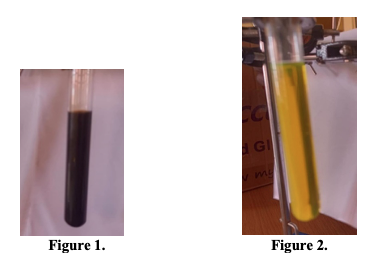
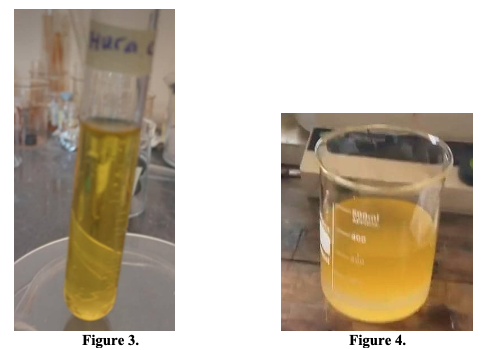
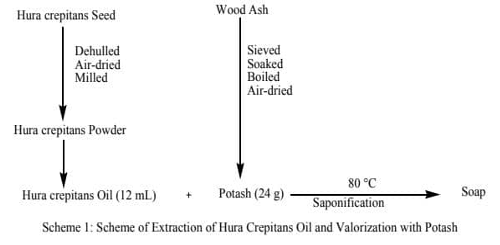
Spent lubricating oil (Figure 1) are complex mixtures resulting from the breakdown of virgin oil (Figure 2) during service. The chemical composition of spent lubricating oil includes hydrocarbons base oil, additives, environmental contaminants, and degradation products. Each component of the oil plays important role in the oil’s function and its degradation over time. Important chemical components of spent lubricating oil include base oil and degraded products. Base oil forms the foundation of lubricating oil and generally accounts for 70–90% of the oil’s composition. They are derived from either petroleum (mineral oil) or synthesized through chemical processes (synthetic oil) [4]. Degraded products: The degradation of lubricating oil results in the formation of various chemical byproducts that compromise the oil’s performance. The degradation is mainly due to thermal break- down, oxidation, and chemical reactions with contaminants. The degraded product occurs in the form of oxidized hydrocarbons and polymerized species. The growing emphasis on environmental sustainability and resource conservation has prompted the exploration of greener strategies for SLO treatment. Among these, rerefining and valorization are increasingly recognized as viable options for recovering useful components from waste oils. These approaches not only reduce the demand for virgin base oils but also support circular economy principles by transforming waste into value-added products. Valorization refers to the process of transforming this waste into valuable products through various recovery or reprocessing methods. Therefore, valorization not only reduces environmental burden but also supports resource recovery and circular economy principles. Valorization which is guided by the 3R concept: Reduce, Reuse, and Recycle, often goes beyond to include energy recovery and upcycling of waste into higher-value products. The objectives of valorization are to: prevent waste from entering landfills, enhance sustainability in production and consumption and stimulate innovation in green technologies or waste management [6]. One of the promising yet underexplored techniques for SLO recovery is the use of bio-based materials in oil purification processes. Nanocrystalline cellulose (NCC), derived from plant biomass, has gained attention as a renewable and efficient separation medium due to its high surface area, biodegradability, and adsorption properties. When integrated into chromatographic systems, NCC can enhance the selective recovery of lighter oil fractions from degraded lubricants. In parallel, the use of non-edible seed oils in industrial formulations such as greases offers an environmentally friendly alternative to petroleum-based ingredients. Hura crepitans (sandbox tree) seed oil (Figure 3), abundant in tropical regions, is a non-edible and renewable resource with suitable physicochemical properties for saponifica- tion and grease production.
Materials and Method Spent lubricating oil was collected from used automobile engines within Ilorin, Nigeria. Hura crepitans seeds were harvested from mature fruits in Ilorin and authenticated at the herbarium of the University of Ilorin. Analytical-grade reagents and solvents including n-hexane, methanol, and sulfuric acid were used. Potash used for saponification was derived from dried wood ash, and nanocrystalline cellulose used as part of the stationary phase for chromatographic separation was obtained as a gift from the department of Chemistry, University of Ilorin, Nigeria.
Extraction of Hura crepitans Seed Oil Harvested Hura crepitans seeds were dehulled, air-dried, and milled into fine powder. Oil extraction was carried out using a reflux system with a solvent mixture of n- hexane, methanol, and sulfuric acid in a ratio of 42:33:1 mL [7]. A total of 110 g of seed powder was refluxed for 1 hour under controlled heat. The resulting mixture was cooled, filtered, and the oil was extracted with hexane. Then, the solvent was recovered by distillation. The oil yield was determined based on the initial seed mass.
Preparation of Soap from Hura crepitans Oil Following standard protocols [8], saponification of the extracted oil was carried out using a potash prepared from 4 cellulose used as part of the stationary phase for chromatographic separation was obtained as a gift from the department of Chemistry, University of Ilorin, Nigeria. ratio of 42:33:1 mL [7]. A total of 110 g of seed powder was refluxed for 1 hour under controlled heat. The resulting mixture was cooled, filtered, and the oil was extracted with hexane. Then, the solvent was recovered by distillation. The oil yield was determined based on the initial seed mass. wood ash. A mixture of 12 mL of seed oil and 24 g of aqueous potash was heated at 80°C with continuous stirring until the formation of a uniform soap mass was observed. The resulting soap was air-dried and stored for use in grease formulation.
Fractionation of Spent Lubricating Oil on Column Chromatography Spent oil samples were subjected to column chromatography to isolate cleaner oil fractions. A glass column (50 cm × 0.5 cm) was packed with a homogeneous blend of silica gel and nanocrystalline cellulose in a 1:1 ratio as the stationary phase. Approximately 15.84 g of spent oil was loaded onto the column and eluted using n-hexane as the mobile phase. Fractions were collected primarily based on color, and elution profile. The recovered oil was classified as dark, medium, and light fractions. The recovered oil fraction was analyzed using gas chromatography–mass spectrumetry (GC-MS) to determine its chemical composition and to assess the efficiency of the recovery process. For comparative purposes, a sample of virgin lubricating oil was also subjected to GC-MS analysis under identical conditions. The resulting chromatographic profiles were evaluated to identify changes in hydrocarbon structure, the pres- ence or removal of degradation products, and the restoration of base oil quality. Grease Formulation Grease was formulated by blending 15 g of Hura crepitans-based soap with 85 g of the recovered oil fraction. The mixture was heated to approximately 100°C and stirred continuously until a smooth, homogenous grease was obtained. The prepared grease was allowed to cool and stored for physicochemical analysis. Physicochemical Analysis Following standard procedure [9,10], the following analyses were conducted on the virgin oil, spent oil, recovered oil, and seed oil: Specific Gravity: The specific gravity of virgin, spent, and Hura crepitans oil was measured using a pycnometer. It was weighed empty, with water, and with each oil sample, ensuring no air bubbles and a clean exterior before weighing. Kinematic Viscosity: Viscosity of virgin, spent, and Hura crepitans oil was measured using an Ostwald viscometer, calibrated with distilled water. About 10 ml of each sample was drawn above the upper mark and allowed to flow under gravity. Flow time between two points was recorded with a stopwatch at room temperature. The viscometer was cleaned before each test to ensure accuracy. Pour Point: The pour point (the lowest tem-perature at which oil still flows) was determined for three oil samples (virgin lubricating oil, spent lubricating oil, and Hura crepitans oil). Each sample was placed in a clean test jar with a thermometer and cooled in a controlled bath. At every 3°C drop, the jar was removed and tilted to check for flow, with each check done within 3–5 seconds to prevent temperature rise. The process continued until no flow was observed, and the pour point was recorded as 3°C above that temperature. All apparatus were cleaned and dried after each test. Saponification Value: Evaluated via standard titration using potassium hydroxide and hydrochloric acid. Yield Determination: Percentage yields of extracted and recovered oils were computed based on initial mass. All tests were conducted in triplicate to ensure reproducibility and average recorded.
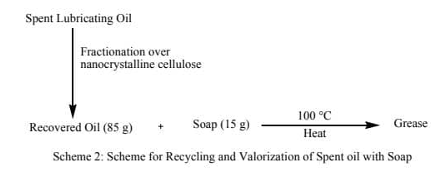
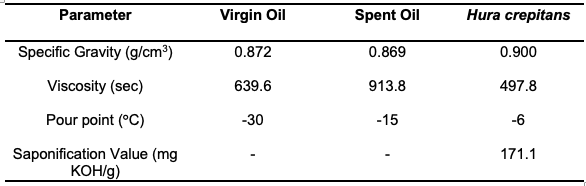
Results and Discussion Hura crepitans seed oil typically appears as a yellowish liquid with moderate viscosity and a density, 0.9-1.0 g/cm³ (Table 1). Its Saponification value indicates its potential for soap production. The recovered oil fraction exhibited im-proved properties compared to untreated spent oil, as shown in Table 1.
Discussion The specific gravity values (Table 1) ob-tained suggest that all three oils are less dense than water, as expected for hydrocarbon-based oils. The spent lubricating oil had a specific gravity of 0.869 g/cm³, slightly lower than the virgin lubricating oil at 0.872 g/cm³, likely due to degradation and accumulation of lighter decomposition by-products over time. This minor decrease is consistent with previously reported changes in density due to oxidative breakdown and contamination in used engine oils [11]. The Hura crepitans seed oil exhibited a high specific gravity at 0.919 g/cm³, indicating a denser molecular composition, possibly due to the presence of higher molecular weight triglycerides and fatty acids. This aligns with findings in plant-based oils known for their higher saturation or functional group content [12]. These differences in specific gravity can influence the applications of each oil, especially in formulations such as grease production, where oil density and viscosity play a role in determining the final product’s performance and texture. The viscosity of spent lubricating oils is often high compared to fresh oil due to oxidation and the presence of contaminants such as soot and metal particles. The high viscosity affects the flow characteristics of the oil and can lead to reduced efficiency in lubrication systems [13]. Virgin oil, being unused and clean, had moderate viscosity. Hura crepitans oil had the lowest viscosity, likely due to its plant-based composition, lighter molecular weight, and minimal impurities. The viscosity trend (Spent > Virgin > Hura) aligns with the impact of degradation and supports Hura oil’s potential use in low-viscosity, eco-friendly lubricants.
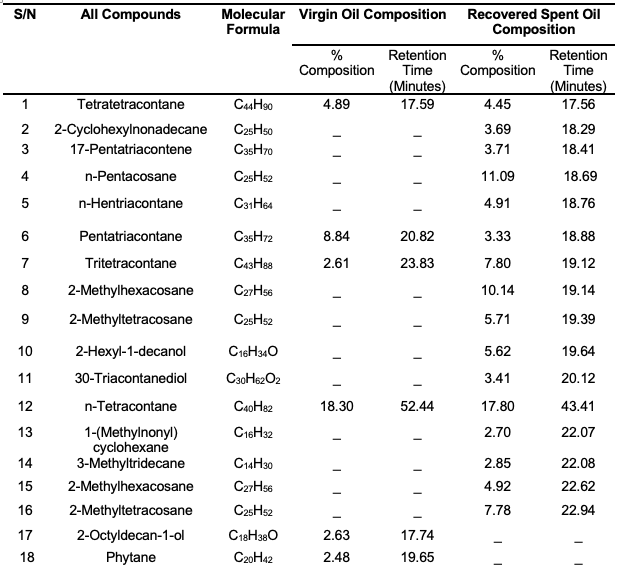
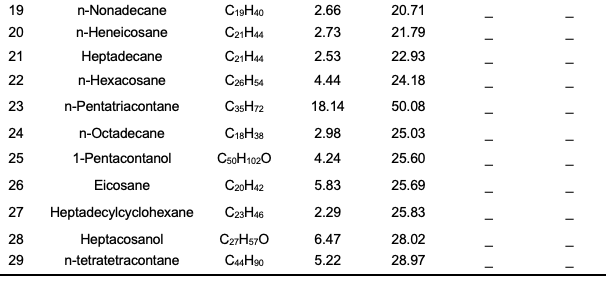
Gas Chromatography – Mass Spectrometry Analysis GC-MS is widely employed for analyzing the volatile and semi-volatile components in spent lubricating oil. It provides a detailed profile of hydrocarbons, degradation products, and contaminants like fuel residues [14]. The chemical composition of the Recovered Spent Oil and the virgin oil was obtained by subjecting them to Gas Chrom-atography-Mass Spectrometry (GC-MS) analysis. Approximately 0.2 g of each sample was diluted in 2.0 mL using hexane and further to a microgram unit before injection into the Shimadzu GC-2010 gas chromatograph. The parameters for the analysis is as indicated: The detector, FID at 220°C, nitrogen gas flowing at 1.0 mL/min on an Optima 35 capillary column (30 m × 0.53 mm ID; 0.32 mm) with a split ratio 1:30 and injector temperature, 250°C.The column temperature was maintained at 40°C for five minutes before increasing to 280°C (5°C/min) with a delay at that temperature for an additional five minutes. For the GC-MS, a Jeol JMS-HX 110 mass spectrometer with a source at 270°C and 70 eV coupled with a Hewlett-Packard 6890 gas chromatograph was used. The injector was configured to split at 1:30 and temperature at 270°C. Compound identification was established by comparing the MS fragmentation with authentic samples and data obtained on the NIST Library Version 3.0 mass spectral software database. The chemical composition of the hexane extracts as obtained from the GC-MS is as shown in Table 2. Gas Chromatography–Mass Spectrometry (GC-MS) was employed to characterize the hydrocarbon composition of virgin (of same origin with the spent) and column recovered oil from spent lubricating oil samples extracted using hexane and purified via column chromatography. Sixteen compounds (Table 2) were identified in both the virgin oil and the recovered spent oil. With four overlaps observed between the two samples, most components were significantly different, indicating major chemical changes to the oil during operation. Although the coinciding compounds had slightly different retention time, this is apparently due to the degree of complexity in both samples.
In both samples, n-tetracontane (C₄₀H₈₂) was the most prevalent of these. It showed up at a retention time of (52.44 mins) with (18.30%) area in virgin oil and at 43.41 minutes with (17.80%) area in recovered spent oil. Its persistence shows that it is thermally resilient, but its decreased abundance in spent oil points to partial breakdown, most likely caused by high-temperature oxi- dative processes. According to Okonkwo et al., in 2023 [15], n-tetracontane is a long-chain linear alkane that greatly enhances the viscosity, lubricity, and film strength of base oils. Its potential application as a molecular fingerprint or marker for oil integrity is supported by its steady presence. Another high-molecular-weight alkane, tetratetra- contane (C₄₄H₉₀), was also present in both oils, with 4.45% in spent oil and 4.89% in virgin oil, and decreases, presumably, as a result of redistribution or degradation during service. These saturated hydrocarbons are typically non-reactive and resistant to cracking, hence their survival in the spent fraction. Several straight-chain and branched alkanes which were exclusive to the virgin oil, include: n-pentatriacontane (18.14%), n-octadecane (2.98%), eicosane (5.83%), 1-pentacontanol (4.24%) and phytane (2.48%). The absence of these in the recovered spent oil suggests that they were either oxidized, volatilized, thermally cracked, or transformed into other hydrocarbons during use. For example, the total absence of n-pentatriacontane, despite its high original abun- dance, may result from oxidative cleavage and conversion into alkenes or branched alkanes. The GC-MS data of the spent oil revealed newly formed compounds not present in the virgin oil, which includes 17-pentatriacontene (2.71%), 2-cyclohexyl-nonadecane (3.69%), 2-hexyl-1-decanol (5.62%), 30- triacontanediol (3.41%). These are probably intermediates of heat degradation or oxidation products. While the emergence of alcohols and diols suggests oxidation at terminal methyl groups, the creation of alkenes (such as 17-pentatriacontene) indicates dehydrogenation events. Finally, the results re-affirm the potential utilization of GC-MS analysis in tracking degradation markers in lubricating oils. Kim et al. in 2014 [16] demonstrated the capability of GC-MS combined with statistical modeling to distinguish between fresh and used oils, a method that parallels the approach in this study.
Conclusion The recycling and valorization of spent lubricating oil presents a sustainable and economically viable approach to mitigating environmental pollution and conserving natural resources. By transforming waste oil into reusable products through processes such as re-refining, distillation, and chemical treatment, this practice not only reduces dependence on virgin crude oil but also supports circular economy principles, by reducing the risks of environmental pollution. Effective recycling strategies help minimize the ecological risks posed by indiscriminate disposal, while valorization enhances the value chain by converting waste into useful secondary products such as fuels, base oils, and additives. As global energy demands continue to rise, the adoption of efficient, eco-friendly recycling technologies for spent lubricants is essential for promoting environmental stewardship and industrial sustainability.
References
|
||||||||||||||||||||||||||