|
Introduction The disposal of huge volumes of synthetic colours in industrial drainage, which is generally untreated effluent, has emerged as a global leading problem threatening environmental systems and making the preservation of human health very hard. Of these dyes, methyl violet 2B (MV-2B) is a cationic dye containing one or two methyl groups bonded to a nitrogen atom and three substituted aryl groups. Due to its stable chromophoric group, MV-2B is used in a number of sectors, including textile, paper, leather, silk, bamboo, and ink, mainly as a dyeing agent [1-4]. Activated carbon (AC) is generally regarded as a premium adsorbent for wastewater treatment and features a plentiful specific surface area, pronounced porosity, various surface functional groups, high adsorption performance, good chemical stability, and easy regeneration. However, the high production cost of activated carbon hinders its large-scale application [11,12]. On the other hand, adsorbents derived from lignocellulosic sources have obtained increasing interest due to their environment-friendly, renewable, cheap, and abundant nature. A plethora of literature has highlighted the efficiency of converting agricultural residues and biomass wastes into adsorbent materials. These include sugarcane bagasse, soybean husks, residues from Moringa oleifera cultivation, sorghum stalks, oil palm fronds and poultry litter, which are highly promising biosorbents for sequestering dyes and other contaminants from wastewater systems [8,13]. Lignocellulosic biomass wastes have traditionally been used to produce activated carbon via thermochemical processes such as conventional pyrolysis or microwave-assisted pyrolysis. Pyrolysis is the most commonly employed method, as it can yield high-quality, porous activated carbon with a high specific surface area. The choice of a suitable chemical activating agent is the most important step in this process, because is the one that dramatically affects the characteristics of the pore structure, pore size distribution and surface area of the carbon products obtained [14,15]. Zinc chloride (ZnCl2), sulfuric acid (H2SO4), phosphoric acid (H3PO4), potassium hydroxide (KOH), and sodium carbonate (Na2CO3) are all widely used activating agents. In particular, zinc chloride (ZnCl2) has been reported to be the most dominant, as it is known for inducing a well-defined porous structure with high surface area and carbon yield. Phosphoric acid (H3PO4)–activated carbon also demonstrated high adsorption performance for various water pollutants. Organic pollutants include malachite green, methylene blue, methyl violet, tetracycline hydrochloride, phenol, etc., as well as toxic metal ions such as Cr(VI) and Cd2+. Rice husk-based activated carbon, for example, showed better adsorption capability towards methyl violet compared to raw rice husk due to improved surface characteristics and an excess of functional groups. The fit of the adsorption process to the Freundlich isotherm indicated heterogeneous multilayer adsorption behaviour. Additionally, this activated carbon demonstrated strong regeneration and reusability, making it a viable and eco-efficient bio-based adsorbent for wastewater treatment applications [16,17]. This research focuses on the using of friendly bioresources for removal of pollutants from aqueous solutions.
Materials
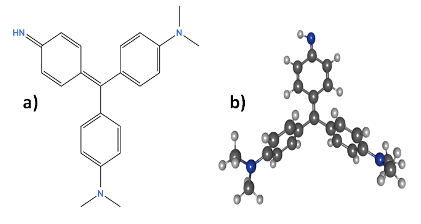
Rice Husk (RH) was collected from a local farm in Hillah, Iraq. Methyl violet dye (as shown in Figure 1) (MV 2B; C24H28ClN3; molecular weight 393.94 g/mol, purity 99.87%, maximum wavelength 575 nm) was obtained from Tianjin Kemou Chemical Co., Ltd. Sodium chloride (NaCl, molecular weight 58.44 g/mol), hydrochloric acid (HCl), sodium hydroxide (NaOH, molecular weight 40 g/mol ), zinc chloride (ZnCl2, molecular weight 136.315 g/mol) and phosphoric acid (H3PO4, molecular weight 97.994 g/mol) were sourced from Sigma-Aldrich.
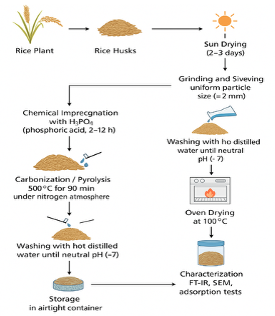
Activated Carbon Preparation from Rice Husk The RH was sourced from farms, left undisturbed, and cleaned with water to remove dirt and issues. They were then left to dry in the sun for three days. After this, the specimens were placed in an oven and heated at 100°C for 24 hours to completely eliminate the surface moisture. These dried husks were then ground in a mortar to a very fine powder and sieved to give 2 mm-sized particles. Subsequently, chemical activation was performed on 1 g of rice husks using 2 g of phosphoric acid (H3PO4). The pulp was then transferred to a deoxygenated furnace and was calcined at 500℃ for 90 min in a nitrogen atmosphere. The activated carbon obtained was called RH-AC and was washed several times with hot distilled water to remove any unreacted acid. The RH-AC powder was dried in an oven at 100°C for 24h after the washing, then sieved to achieve a similar particle size of m, and the final RH-AC powder was retained in a sealed container were carried out the adsorption experiments (Figure 2).
Adsorption Experiment A standard solution of methyl violet (MV) dye with an initial concentration of 100 mg/L was prepared using distilled water. A series of solutions was prepared to obtain the required concentrations. In the adsorption experiments, 100 mL of an MV solution (50 mg/L) was used in a 100 mL conical flask. A weight of activated carbon was used as an adsorbent (0.0600 ± 0.0001 g). A shaker was used in a temperature-controlled water bath, and the mixture was shaken at 150 rpm for one hour to ensure that the adsorption equilibrium was reached – a standard study. To systematically evaluate the adsorption behaviour, the effect of several experimental variables was investigated: contact time, which was set within a range of 5 to 60 minutes; and the initial dye concentration, which ranged from 10 to 100 mg/L. The pH of the solution is controlled between 3 and 10 using 0.1 M sodium hydroxide or 0.1 M hydrochloric acid. Following each experiment, the residual MV dye concentration in the supernatant was determined using a UV–Vis spectrophotometer at the maximum absorption wavelength (λmax = 580 nm). The adsorption capacity and removal efficiency were subsequently calculated based on the difference between the initial and equilibrium concentrations of the dye (equations 1 and 2)[18]. Where Co (mg/L) is the initial concentration of dye, and Ce (mg/L) is the concentration of dye at equilibrium.
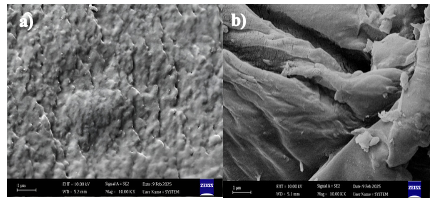
Results and Discussion Morphology Studies (FESEM) Figure 3a of the field-emission scanning electron microscopy (FESEM) image of phosphoric acid-activated rice husk-derived activated carbon shows a heterogeneous and rough surface morphology. The image reveals a highly uneven surface with numerous holes and wrinkles, which are characteristic of successful chemical activation. The porous structure was formed through dehydration and oxidation during the activation of H3POH, which promoted the formation of micro–mesopores through volatilisation and disruption of the lignocellulosic matrix [19,20]. The higher the activated carbon, the rougher and more porous its surface (characteristics related to a greater surface area and a higher density of embedded sites, both of which are important for achieving efficient adsorption) is. The uneven or coarse surface of this activated carbon indicates the suitability for applications such as dye removal from aqueous solutions (i.e., environmental remediation) [21,22]. The FESEM micrograph of activated carbon after adsorption of MV dye reveals significant changes in surface morphology compared to the pre-adsorption structure. The rough, porous surface appears smoother and partially covered, indicating that the dye molecules penetrate most of the active sites on the surface and fill most of the pores and surface cavities [23,24]. The appearance of deposits as clumps on the prepared surface usually indicates strong interactions between dye molecules and the active sites on the carbon surface, likely involving π–π stacking, electrostatic attraction, and hydrogen bonding. The reduced visibility of the microporosity confirms the success of the adsorption process and the efficiency of activated carbon in removing dye from aqueous solutions, as shown in Figure 3b [25].
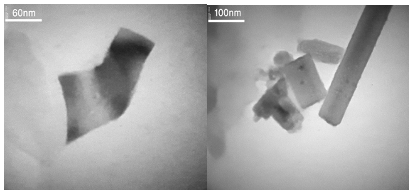
Transmission Electron Microscopy (TEM) Transmission electron microscopy (TEM) images show the nanostructure of rice husks from which phosphoric acid-activated carbon was prepared (Figure 4).
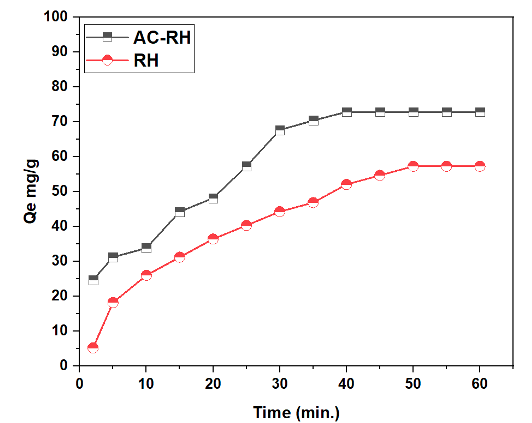
Two-dimensional (60 nm scale) images reveal thin, sheet-like carbon structures with irregular shapes, indicating partial crystallization and layered structure formation through acid activation. Further crystallization and more regular shapes are observed, confirming the successful activation process. The second image (100 nm scale) shows irregular and rod-like shapes. The variety of molecular shapes reflects the heterogeneous decomposition of rice husks during activation and carbonization. The combination of sheet-like shapes and aggregated nanostructures demonstrates that H3PO4 activation yields a porous, heterogeneous structure that is beneficial for adsorption applications [26,27]. Specific Surface Area Using the adsorption/separation method with nitrogen, the specific surface area of acid-activated carbon (AC-RH) was determined, providing insight into its pore structure and surface reactivity. The Brunauer-Emmett-Teller (BET) method was employed. This technique evaluates gas adsorption onto a solid surface. The adsorption curve conformed to the IUPAC type IV adsorption curve, reflecting the presence of micro- and intermediate porosity bands. The appearance of H3 retardation rings confirmed the presence of cleavage-shaped pores and irregular pore shapes, characteristic features of layered carbon materials, demonstrating its efficiency as a porous adsorbent for gas-solid interaction studies. Therefore, the acid-activated carbon exhibited a specific surface area (BET) of 2.31 cm³/g [28]. Effect of the Contact Time In this study, the equilibrium time (5–60 minutes) for the adsorption efficiency of methyl violet (MV) dye was determined under constant experimental conditions: sample volume (100 mL), rice husk-enhanced activated carbon dosage (0.06), pH (5), and dye concentration (50 mg/L), as shown in Figure 5.
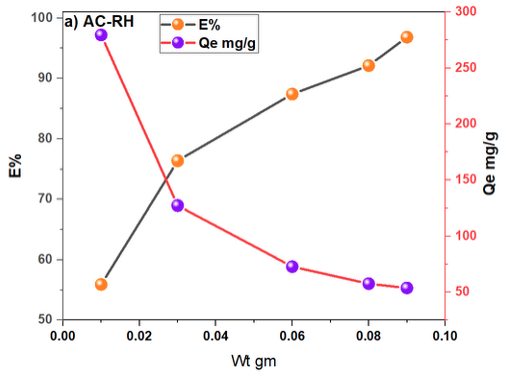
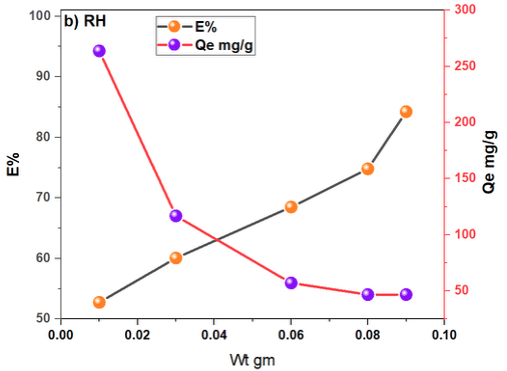
The adsorption efficiency increased over time, reaching a removal rate of 87% for rice husk-enhanced activated carbon (AC-RH) and 68% for raw rice husk (RH). After this point, all sites reached complete saturation, resulting in a stable removal rate. This shows the saturation of the adsorption sites, indicating that no additional dye could be adsorbed. Notably, rice husk-derived activated carbon exhibited higher removal and adsorption efficiencies than raw rice husk. This improved performance is due to activated carbon having more active sites than unactivated carbon. This is a result of activation, which creates more surface sites and higher surface area, thereby enhancing interaction with MV molecules. On the contrary, functional sites are absent in raw rice husks; therefore, raw rice husks cannot effectively remove the dye. An optimal contact time of 60 minutes was chosen for further experiments based on the results shown in Figure 5. Effect of AC-RC Mass The influence of AC-RH mass on the adsorption efficiency of methyl violet (MV) dye was examined within the range of 0.01–0.09 g, while maintaining all other parameters constant. As shown in Figure 6, MV dye removal efficiency increased from 70% to 86% as the adsorbent mass was raised from 0.01 to 0.06 g [29,30].
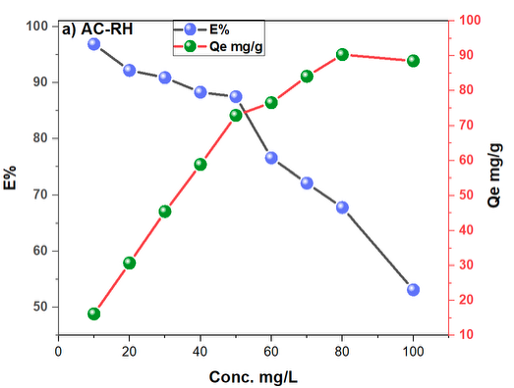
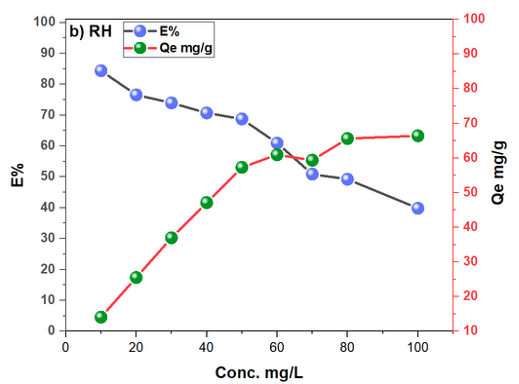
The maximum efficiency was achieved at 0.06 g, which can be attributed to the greater availability of active binding sites as the adsorbent dosage increased. However, a further increase to 0.09 g resulted in a slight decline in extraction efficiency, likely due to particle aggregation at higher dosages that reduces the effective surface area. Therefore, an AC-RH mass of 0.06 g was selected as the optimum dosage for subsequent experiments [31-33]. Effect of Initial Concentration of MV Dye The influence of the initial MV dye concentration on adsorption performance was systematically investigated at pH 8 over the range 10–100 mg/L.
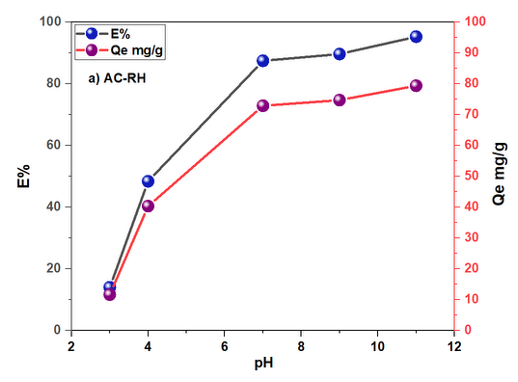
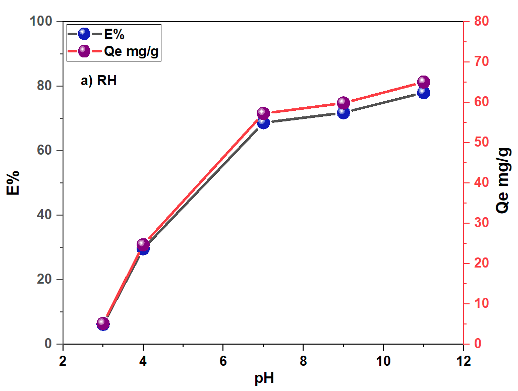
As illustrated in Figure 7, an increase in dye concentration resulted in an apparent rise in adsorption capacity (qe). This behaviour can be explained by the enhanced driving force for mass transfer at higher concentrations, which facilitates the diffusion of dye molecules from the solution to the surface of the adsorbent [3,34,35]. Thus, more dye molecules are adsorbed per unit mass of adsorbent as the concentration increases. As the dye concentration increases, the adsorption efficiency increases, while conversely, the removal percentage (%) decreases. This decrease in adsorption efficiency is usually attributed to saturation of the adsorbent surface with available adsorption sites, which cannot accommodate the excess number of dye ions at high concentrations. In other words, although each gram of adsorbent binds a greater quantity of dye at high concentrations, the removal percentage decreases because the number of dye molecules is much greater than the number of active sites. These results demonstrate that lower concentrations improve removal efficiency by increasing diffusion and intermolecular forces, but they also reduce it due to limited adsorption sites and surface-site saturation with dye [36,37]. Effect of pH of Solution The effect of pH on the adsorption of methyl violet (MV) dye using rice husk activated carbon (AC-RH) and raw rice husk (RH) was investigated under optimal experimental conditions (initial dye concentration: 50 mg/L, activated carbon weight: 0.06 g, contact time: 60 minutes, stirring speed: 190 rpm, temperature: 25°C). The activated carbon demonstrated significantly higher efficiency than unactivated carbon, with average values of 95.63% for AC-RH and 78.11% for RH. The corresponding adsorption capacities were calculated to be 79.61 mg/g for AC-RH and 67.64 mg/g for RH, as shown in Figure 8. This indicates that the adsorption process relies primarily on pore filling rather than electrostatic interactions [16,38-40].
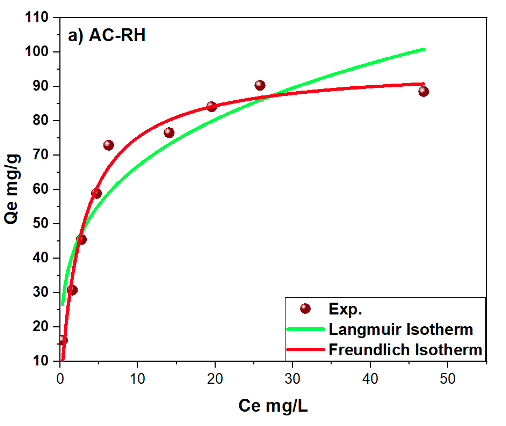
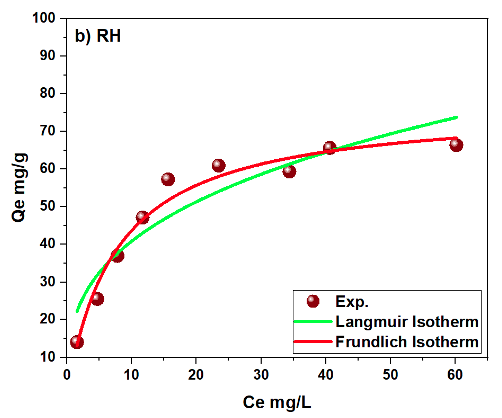
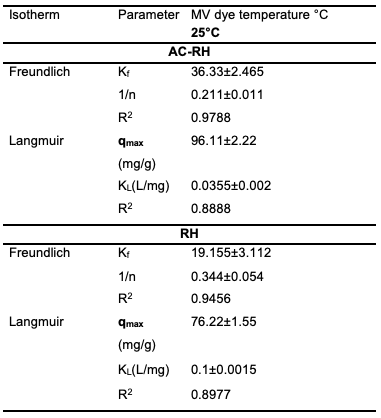
Adsorption Isotherm Curves Adsorption isotherm models are used to correlate the amount of dye adsorbed at the solid/liquid interface with its solution concentration [41,42]. The Langmuir and the Freundlich models were used to describe the experimental data in this research. Langmuir theory assumes that adsorption occurs at a homogeneous surface, forming a saturated monolayer with no interactions among adsorbed molecules. Nevertheless, the Langmuir model did not fit the experimental data well (R2 = 0.8888), as presented in Table 1. From the fitted Freundlich model, the maximum adsorption capacity was calculated to be 96.11 mg/g at 25°C. A good agreement is observed between this value and the previously reported one, indicating that the physisorption process occurs on a heterogeneous surface with a non-uniform distribution of active sites [43,44].
These results suggest that the Freundlich model provides a better fit for dye adsorption on H3PO4-modified activated carbon, as also reported elsewhere for similar adsorbents (Figure 9). Beyond statistical fitting, the better conformity of the adsorption data with the Freundlich isotherm indicates adsorption on a heterogeneous surface with multilayer formation. This behaviour is attributed to the presence of diverse functional groups and pore structures that enable multiple interactions such as electrostatic attraction, hydrogen bonding, and π–π interactions. In contrast, the Langmuir model assumes a homogeneous surface and monolayer adsorption, which may occur only at specific high-energy sites.
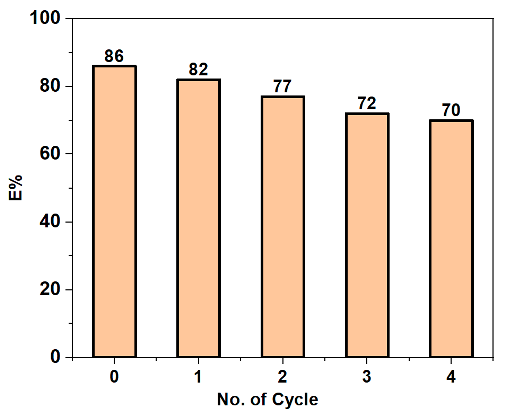
Adsorption Desorption Figure 10 illustrates the effect of regeneration cycles on the removal efficiency of methyl violet dye.
The adsorption efficiency was initially high, reaching about 86% in the first cycle, and then gradually decreased with increasing reuse cycles to approximately 70% after the fourth cycle. This reduction can be attributed to the partial saturation of active adsorption sites, incomplete desorption of dye molecules during regeneration, and possible pore blockage or slight structural changes in the adsorbent. Nevertheless, the adsorbent maintained relatively good removal efficiency after multiple cycles, indicating acceptable stability and reusability for methyl violet removal from contaminated water [45].
Conclusion This study investigated the preparation of high-surface-area, high-adsorption-efficiency activated carbon from rice husks (AC-RH) for the removal of methyl violet (MV) dye. The phosphoric acid-activated husks exhibited significantly higher adsorption efficiency compared to untreated rice husks, highlighting the role of chemical activation. Several adsorption factors were investigated, including dye concentration, activated carbon weight, and pH of solution. A maximum removal rate from an alkaline medium (pH 11) also indicated the electrostatic interaction mechanism in the adsorption process. At experimental conditions: 0.06 g/100 mL, pH 11, 25°C, the maximum adsorption performance for AC-RH was observed, with a removal rate of methyl violet (MV) as high as 87.89%, which is much higher than that of raw rice husks (68.13%). Adsorption isotherms were also analysed and were found to conform to the Freundlich adsorption model (R2 = 0.9788), denoting heterogeneous multilayer adsorption on the adsorbent surface. The best dye removal (97.66 mg/g) was achieved, significantly higher than that of untreated rice husks, confirming that chemical activation is an excellent treatment for improving surface properties and porosity. The adsorption efficiency was initially high, and then gradually decreased with increasing reuse cycles to approximately 70% after the fourth cycle. In conclusion, rice husk-derived activated carbon is a low-cost, eco-friendly, and efficient adsorbent for the removal of alkaline dyes from wastewater and can be employed as a better alternative for dye adsorption compared to conventional adsorbents.
References
|
||||||||||||||||||||||||||||||||||||||||